Required Permissions
There are three permissions that govern the ability to add skilled staff members to a single controlled document and manage skills:
- Skilled Staff: Add Skilled Staff - allows adding both trained and untrained skilled staff to a controlled document
- Skilled Staff: Delete Skilled Staff - allows deleting both trained and untrained skilled staff from controlled documents
- Skilled Staff: Verify Skill - allows a user to be a verifier of skills within a given OU
Not every system role that has the word ‘Editor’ in it contains the first two permissions above. They are included in the SOP Editor, Document Editor, Policies Editor, External Document Editor, H&S Editor, Equipment Editor, Reagent Editor, Material Editor, COSHH Editor, Personnel Management Editor, Administration Editor, Global Editor (excluding admin and personnel records) and Global Editor (excluding admin) roles, but only the Administration Editor role includes them all.
| Tip |
There are several ways to interrogate what permissions are used in roles with the search facilities available. 1. Navigate to Administration > Roles > Search Roles 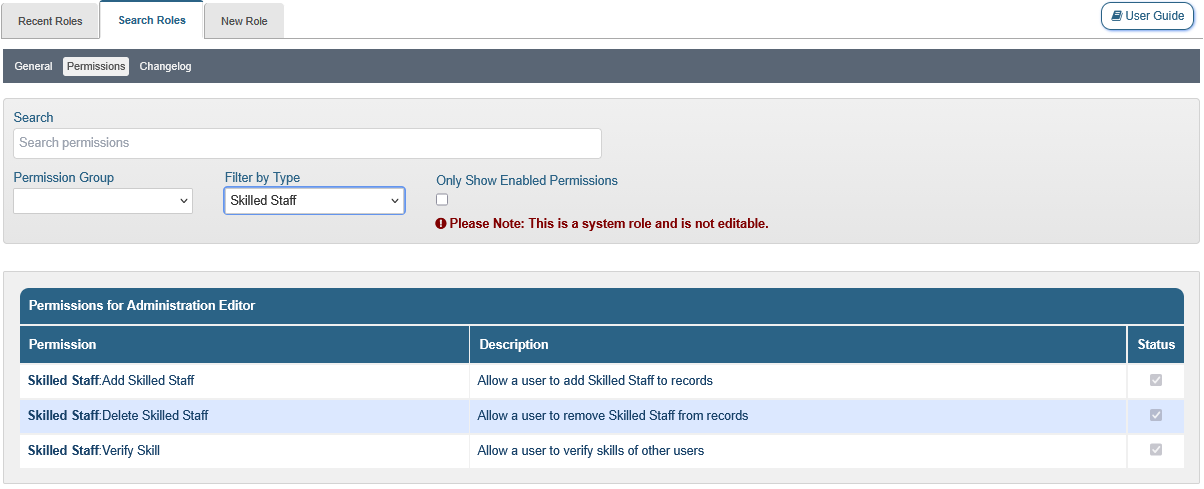 |
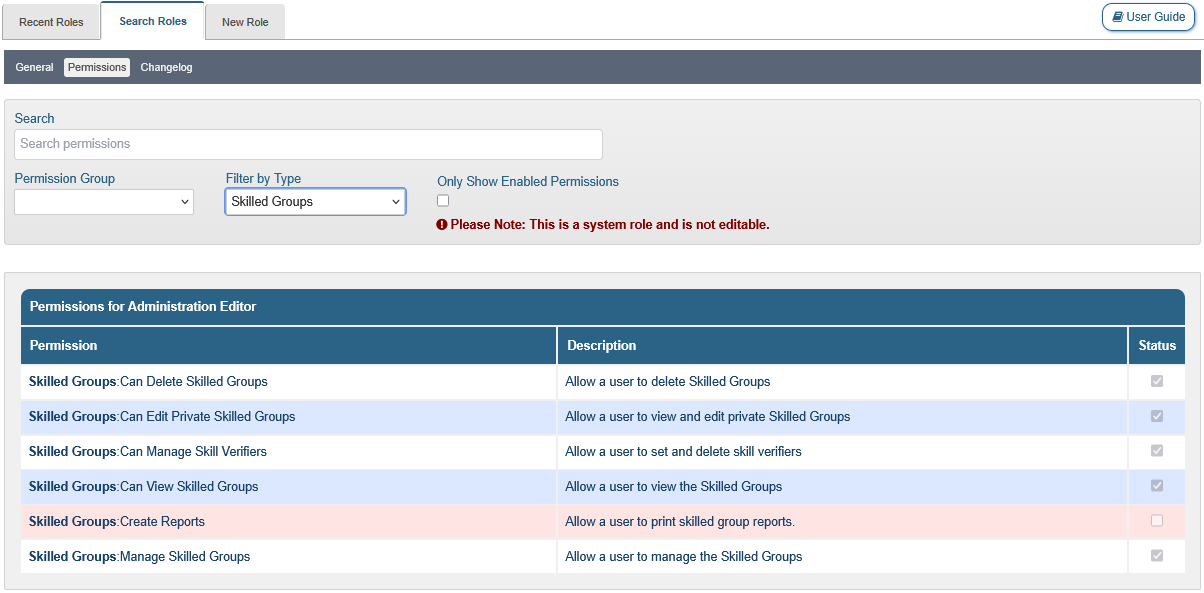
There are 6 permissions that relate to ‘Skilled Group’ management (and can be viewed using the same method above):
- Desktop: Show Skilled Groups Menu Item - without this permission, a user won’t even see the sub-menu item, Skilled Groups under the menu, Competency
- Skilled Groups: Can View Skilled Groups - allows a user to view skilled groups
- Skilled Groups: Manage Skilled Groups - allows a user to create and edit normal skilled groups (this permission also allows the user to view skilled groups)
- Skilled Groups: Can Edit Private Skilled Groups - allows a user to edit existing private skilled groups
- Skilled Groups: Can Manage Skill Verifiers - allows a user to add and delete skill verifiers
- Skilled Groups: Can Delete Skilled Groups - provides the ability to delete skilled groups
These are only included in the system role, Administration Editor.
Skilled Settings
Skilled Tasks Settings
The settings for skilled tasks operate at OU level and apply to the documents from that OU. In this sense, a skilled group can contain documents from different OUs with different settings. For example, the same skilled group can contain documents from one OU that require verification of the skill confirmation and from another OU that don’t require verification.
An individual controlled document can also have its own reissue interval, which overrides the OU setting for its document type. Users who can manage the OU’s settings can set this from Actions > Skill Reissue Interval on the controlled document. Entering “0d” there turns off automatic reissue for that document.
To open the Skilled Task Settings page:
- Go to Administration > Settings > Organisational Unit Preferences
- Click in the Organisational Unit field and select the relevant OU from the dropdown menu
Info If the Organisational Unit drop-down menu field is not available, it means the user only has access to the settings for one OU and the others are not accessible, so the selector is not required. - Click on the Skilled tasks settings row
The following settings are available:
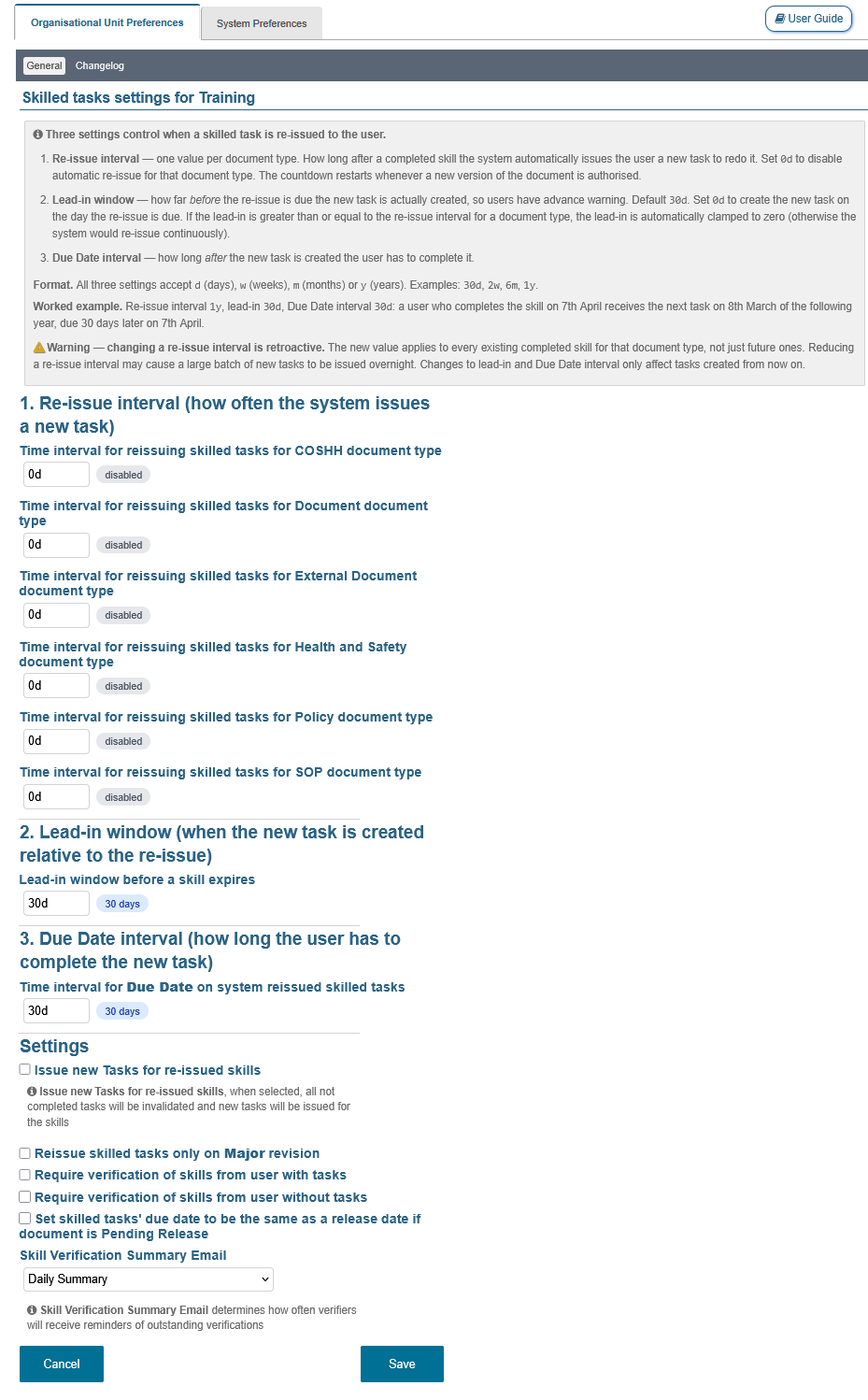
The reissue interval, lead-in window and due date settings are grouped under the headings 1. Re-issue interval, 2. Lead-in window and 3. Due Date interval, and a help panel on the page explains how these three settings work together.
- Time interval for reissuing skilled tasks for SOP document type
- Time interval for reissuing skilled tasks for Document document type
- Time interval for reissuing skilled tasks for COSHH document type
- Time interval for reissuing skilled tasks for Policy document type
- Time interval for reissuing skilled tasks for External Document document type
- Time interval for reissuing skilled tasks for Health and Safety document type
All the ‘Time interval for reissuing skilled tasks for…’ settings above define the time in which the system will automatically reissue skilled tasks for a particular type of document. The time interval starts when the previous skilled task is completed and unless the document version becomes superseded or inactivated, a new skilled task is reissued at the end of the interval. The new task is created ahead of the end of the interval, according to the Lead-in window before a skill expires setting (see below). If a new version of the document is released during that period, the system will immediately create a new skilled task on the basis that the document has changed and must be re-read. The clock then starts counting again so that no longer than the time interval declared lapses before a skilled task is reissued and the user has to refresh their knowledge.
The time interval can be entered using either units of days, weeks, months or years. For example, to enter a time interval of one year, type, “1y” ("d" for days, “w” for weeks, “m” for months). Entering “0d” (the default) turns off automatic reissue for that document type.
Changing a reissue interval is retroactive. When saving the change, a confirmation warning is shown, because the next overnight job re-checks every completed skill in the OU against the new value, which may create a large batch of new skilled tasks at once. - Lead-in window before a skill expires
This defines how far before the reissue is due the new skilled task is actually created, so users have advance warning. The default is “30d”; entering “0d” creates the new task on the day the reissue is due. It is entered using the same units as the reissue intervals. If the lead-in window is equal to or longer than the reissue interval for a document type, the lead-in window is treated as zero for that document type. Changes to the lead-in window only affect tasks created from then on.
| Info |
| For Example: A particular document (with a skill reissue interval set to 1 year) has User1 and User2 on its skilled list. User1 completed their reading task on August 1st, 2019, which coincides with an extended time User2 was taking out of work. Therefore, User2 did not complete their own skilled task until October 1st, 2019. Unless a new version of the document was released in the interim or the document was retired, User1’s skill is due to be reissued on August 1st, 2020 whereas User2’s is not due until October 1st, 2020. With the default lead-in window of 30 days, each user receives their new skill task around 30 days before that date, so User1 receives theirs in early July 2020 and User2 in early September 2020. This process works the same if user(s) are added to the skilled list at any time during the lifespan of the document’s version. |
- Require verification of skills from user with tasks
If a person becomes skilled on a document by receiving a skill confirmation task (please refer to the option, Add Untrained Staff below), a verification will be requested from appointed verifiers when this setting is enabled. The verifier can report having seen some type of evidence or enter comments about how they confirmed that the user read and understood the assignment. - Require verification of skills from user without tasks
If this setting is enabled, a verifier will have to approve the skill when a staff member is added without issuing a skilled task (please refer to the option, Add Trained Staff below). - Skill Verification Summary Email
This dropdown sets how often verifiers receive an email summary of skills awaiting their verification: No Email, Daily Summary or Weekly Summary (sent on Mondays). Skill verification email summaries are sent to those staff marked as verifiers for the particular OU, and to any verifiers added to an individual document (Actions > Override Verifiers). The reminders are based on the OU the document resides in and not the user’s Home OU (their Department), and are only sent for documents from an OU where Require verification of skills from user with tasks is enabled. Only skilled items that can be verified (awaiting verification) will be listed within the email. - Issue New Tasks for re-issued skills
When checked, this works in conjunction with the ‘Time interval’ preferences. The system automatically re-issues tasks for all except revoked skills. If a user has not confirmed a skilled task by the time a new one is to be issued, then it will be marked as invalid by iPassport and replaced with a new task. - Reissue skilled tasks only on Major revision
With this preference enabled, the system automatically reissues skills only when a major revision is released (e.g., from version 1.3 to version 2.0). There is an override option when a new version is being authorised (or an authorisation request is being filled out). - Time interval for Due Date on system reissued skilled tasks
A deadline can be set for skilled tasks here. It’s the time by which a task must be completed once it’s issued, entered using the same units as the reissue intervals (for example, “30d”, “2w”, “6m” or “1y”). A plain number is treated as days.
It is possible to override the default due date at the point of authorising the controlled document (or filling an authorisation request). This new date would be applied to everyone on the skill list of the document at the time of authorisation.
| Note |
The ‘Due On’ and the ‘Completed Date’ of skilled tasks are visible within the Skilled tab of the controlled document and when exporting details from the Tasks area. |
- Set skilled tasks’ due date to be the same as a release date if document is Pending Release
This allows admin to set the due date for the skilled tasks to match the release date of a controlled document, if a future release date is entered when authorising it. This is useful when documents need to be read before they are implemented (for example, a new standard operating procedure that everyone needs to adhere to once it goes into circulation).
Please remember all skilled settings are OU based (apart from any Skill Reissue Interval set on an individual document), which means that any changes will only be applied to documents from the particular OU selected. Also, changes not saved before navigating away from the settings page will be lost.
Document Control
In each OU, a preference can be set to override permissions and allow access to users who have been issued a skill confirmation task. This provides a simple way of ensuring users from different departments can view documents they need to read.
To adjust this setting:
- Go to Administration > Settings > Organisational Unit Preferences
- Click in the Organisational Unit field and select the relevant OU from the dropdown menu
Info If the Organisational Unit drop-down menu field is not available, it means the user only has access to the settings for one OU and the others are not accessible, so the selector is not required. - Click on the Document Control row
- Locate the preference, ‘Allow users with a skilled task to view authorised controlled documents without explicit permissions.’ under the section, ‘Document Access Controls’
- Tick/untick the checkbox for this preference as required
- Scroll down and click Save
Next Step:
The next article covers Adding Skilled Staff to a Document
Previous Step:
The previous article covers Skill Management Introduction
Was this article helpful?
That’s Great!
Thank you for your feedback
Sorry! We couldn't be helpful
Thank you for your feedback
Feedback sent
We appreciate your effort and will try to fix the article