Introduction
iPassport provides all the tools you need in order to create your own custom cover pages. This allows you to include any branding as well as defining which document-specific data iPassport should stamp onto the cover page for each print.
Cover Pages can be configured differently for each organisational unit / document type combination. For example, the information that you wish to include in your cover sheets for SOPs in the Blood Bank OU may be completely different from that used with Policy Documents in the Radiology OU.
iPassport includes a cover page editor which facilitates the creation of cover page templates. These can then be assigned to documents based on organisational unit and document type.
Creating a New Cover Page
| Note |
| Two separate permissions are involved. Viewing, creating and editing a cover page requires the Create/Edit Coverpages permission, while the Cover Pages entry on the Administration menu is controlled separately by Desktop:Show Cover Pages Menu Item. A user who holds Create/Edit Coverpages but not the menu item will not see the menu entry described below. |
From the Administration menu, select Cover Pages then select the New Cover Page tab.
Give your new cover page template a name and (optionally) add a description then click Create Cover Page.
On enterprise accounts the form also offers a Select Facility field. This is optional. Leaving it blank makes the cover page available to every organisational unit on the account; choosing a facility restricts the cover page to the OUs in that facility, adds the facility code beside its name in lists, and narrows the Apply to all documents action described below to that facility only. If a cover page that belongs to a facility is later found in use in an OU outside it, the cover page record displays a warning listing those OUs.
You have now created an empty cover page template. Clicking the Edit Cover Page button will open up the cover page editor and allow the template to be configured.
The List Cover Page tab lists your existing cover pages, each row carrying a View icon and a delete icon. Deleting asks you to confirm with “Are you sure you wish to remove this cover page?” and then removes the cover page from the list. The cover page record itself has two tabs, General and Changelog, the latter showing the history of changes made to the record.
Upload Cover Page Background
The first step is to upload your background. This typically contains your branding but could also include any text etc. that you want to print on any page.
The easiest way create your background page is to build it in MS Word. Add in any images and static text as you would like them to appear on the cover page then save the file as a PDF (typically done by selecting File / Save As and choosing PDF, but this can change between versions of MS Word).
Back in the Cover Page Editor in iPassport click the Upload Background PDF button in the right menu. You will be presented with a tool allowing you to upload the PDF that you would like to use as the background to your cover page.

The template builder will refresh, with your cover page background displayed:

Now it’s time to add some fields to this page!
Adding Fields to a Cover Page
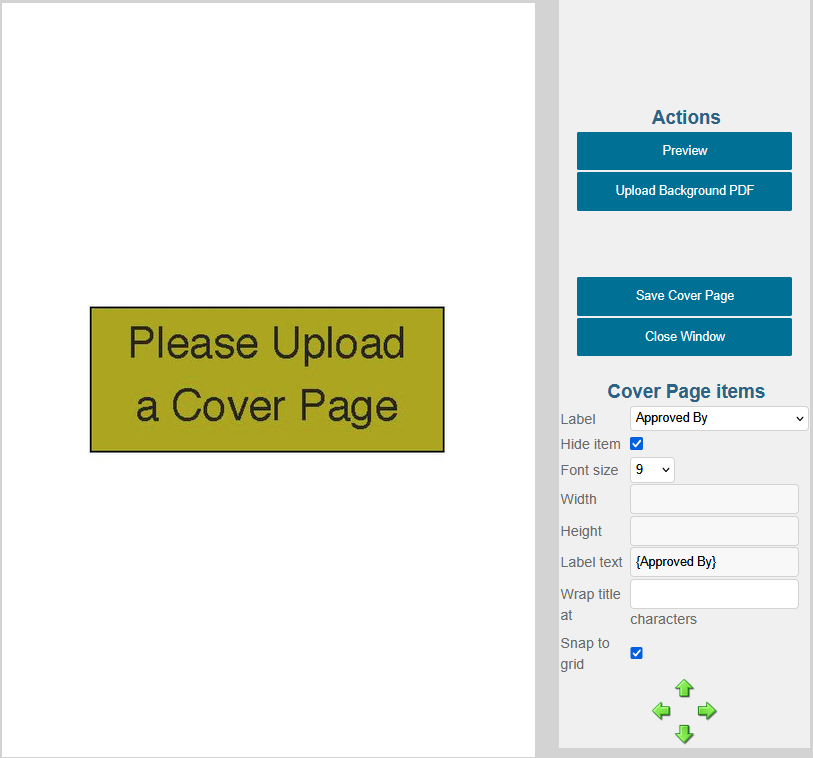
The Cover Page items tools allow fields and labels to be placed on your cover page.

Select a field from the Label drop down then use the Hide Item checkbox to control if this field should be displayed or hidden. All fields are hidden by default.
Once the Hide Item field is unchecked the field will be displayed on the screen and highlighted in red (indicating that this is the selected field). You can now move this field around on the page and change its font size. Font size is a fixed list of 9, 10, 12, 14, 18 and 24 rather than a free text box.
The Wrap title at box, which establishes when the text should wrap onto the next line, is only shown for the nine fields that can hold a long value — Title, Subject, Section, Authors, Document Owners, Authorised By, Approved By, Last Major Version Authorised By and Organisational Unit Name. It defaults to 60 characters. For every other field the box is hidden, because those values are not wrapped.
A few further controls in the editor are worth knowing about:
- The editor opens in its own browser window rather than in the page, so use the Close Window button in the Actions panel when you have finished.
- Items can be dragged and dropped into position with the mouse, or moved with the four green arrow buttons beneath the panel, or with the keyboard arrow keys — 5 pixels a press, or 20 pixels with Shift held.
- Snap to grid is ticked by default and aligns items to a 10 pixel grid as you move them. Untick it for finer positioning.
- Hold Alt and press the up or down arrow to step the selected item’s font size through the list, and press Tab or Shift + Tab to move the selection to the next or previous field.
- The Width and Height boxes are only enabled for the signature fields, which are images. For every other field they are greyed out.
Your changes are only kept when you click Save Cover Page in the Actions panel. Moving, resizing, unhiding or relabelling a field changes it on screen only until you save.
| Note |
| Preview does not save your work first. The preview is generated from the last saved version of the cover page, so any changes you have made since your last save will not appear in it. Always click Save Cover Page before using Preview, and again before Close Window — unsaved changes are lost when the editor window is closed. |
| Tip |
| The best approach to building your cover page is trial and error. Set up your fields as best you can, click Save Cover Page, use the Preview option to see how it looks, then apply the cover page to some of your documents and create a print. You might not get it perfect first time and it may be necessary to return to the cover page editor to fine tune your design |
Cover Page Fields
The following fields can be added to the cover page:
| Field | Description |
|---|---|
| Title | The document’s Title |
| Subject | The Subject given to the document |
| Code | The document’s Index |
| Version | The Version of the document. While the document is a draft this field stamps “N/A” rather than a version number. |
| Authors | A comma separated list of all Authors |
| Release Date | The document’s Release/Effective Date |
| Document Category | The document’s Category |
| Document Type | The document’s Type (e.g. SOP) |
| Authorised By | A comma separated list of everyone who authorised this version of the document |
| Authorised By Signature One | The signature of the most recent authoriser of this version of the document (a user’s signature image can be uploaded in the User Admin area) |
| Authorised By One | The name of the user who most recently authorised this version of the document |
| Authorised By One Date | The date and time at which that authorisation was given |
| Authorised By Signature Two | The signature of the second most recent authoriser of this version of the document |
| Authorised By Two | The name of the second most recent user to authorise this version of the document |
| Authorised By Two Date | The date and time at which that authorisation was given |
| Authorised By Signature Three | The signature of the third most recent authoriser of this version of the document |
| Authorised By Three | The name of the third most recent user to authorise this version of the document |
| Authorised By Three Date | The date and time at which that authorisation was given |
| Authorised Date | The date and time at which this version was authorised. Where authorisation is held back because a future release date has been set, this is still the moment authorisation was given, so it can fall before the document is published. |
| Approved By | A comma separated list of everyone who approved this version of the document in its last completed approval workflow |
| Approved By Signature One | The signature of the most recent approver from the document’s last completed approval workflow |
| Approved By One | The name of the most recent approver from the document’s last completed approval workflow |
| Approved By One Date | The date and time at which that approval was completed |
| Approved By Signature Two | The signature of the second most recent approver from that workflow |
| Approved By Two | The name of the second most recent approver from that workflow |
| Approved By Two Date | The date and time at which that approval was completed |
| Approved By Signature Three | The signature of the third most recent approver from that workflow |
| Approved By Three | The name of the third most recent approver from that workflow |
| Approved By Three Date | The date and time at which that approval was completed |
| Review Date | The document’s next Review Date |
| Location of Copy | The Location of this print |
| Section | The Section selected for this document |
| Last Updated | The most recent change to any of this document’s metadata |
| Date/Time of Print | A timestamp of when the print was created. On an uncontrolled print this field stamps “UNCONTROLLED COPY” instead, and on a preview it stamps “PREVIEW ONLY - UNCONTROLLED”, so on those prints it is not a timestamp at all. |
| Organisational Unit Name | The OU that this document belongs to |
| Document Status | The Status at the document at the time of printing (e.g. Authorised / Draft) |
| Number of Copies | The number of prints in circulation at the time. On anything other than a controlled print this field stamps “N/A”. |
| Print History | A history of other controlled prints of this version of the document, limited to the three most recent. The running “Copy” number counts the true total, so where there are more than three other prints only the last three lines are stamped. Uncontrolled prints are not included, and where there is no controlled print history at all the field stamps “No recorded print history”. |
| Last Reviewed By | The person who completed the last compulsory review (the person who closed out the previous review cycle) |
| Reviewed On | The date the last compulsory review of this document took place. |
| First Version Created On | The date the first version of this document was added to iPassport |
| Document Owners | A comma separated list of all document owners |
| Last Major Version Authorised By | A comma separated list of everyone who authorised the document’s last major version |
| Last Major Version | The version number of the document’s last major version |
The signature, name and date fields for authorisers and approvers are only stamped on a print of a document that is no longer a draft, and the Approved By fields are only filled in where the document has been through an approval workflow. Where there is no matching authoriser or approver, the field is left empty.
The following Label fields are also available. These stamp a plain text label on the page. The wording shown below is the default for a newly created cover page; it can be changed for any label using the Label text box in the editor, so an existing cover page may print something different:
| Field | Default Text Printed on the Cover Page |
|---|---|
| Title Label | “Title: ” |
| Subject Label | “Subject: ” |
| Code Label | “Code: ” |
| Version Label | “Version: ” |
| Authors Label | “Authors: ” |
| Release Date Label | “Release Date: ” |
| Document Category Label | “Document Category: ” |
| Document Type Label | “Document Type: ” |
| Authorised By Label | “Authorised By: ” |
| Authorised By Signature One Label | “Authorised By Signature: ” |
| Authorised By One Label | “Authorised By Signature Name: ” |
| Authorised By One Date Label | “Authorised User Date: ” |
| Authorised By Signature Two Label | “Authorised By Signature Two: ” |
| Authorised By Two Label | “Authorised By Signature Name Two: ” |
| Authorised By Two Date Label | “Authorised User Two Date: ” |
| Authorised By Signature Three Label | “Authorised By Signature Three: ” |
| Authorised By Three Label | “Authorised By Signature Name Three: ” |
| Authorised By Three Date Label | “Authorised User Three Date: ” |
| Authorised Date Label | “Authorised Date: ” |
| Approved By Label | “Approved By: ” |
| Approved By Signature One Label | “Approved By Signature: ” |
| Approved By One Label | “Approved By Signature Name: ” |
| Approved By One Date Label | “Approved User Date: ” |
| Approved By Signature Two Label | “Approved By Signature Two: ” |
| Approved By Two Label | “Approved By Signature Name Two: ” |
| Approved By Two Date Label | “Approved User Two Date: ” |
| Approved By Signature Three Label | “Approved By Signature Three: ” |
| Approved By Three Label | “Approved By Signature Name Three: ” |
| Approved By Three Date Label | “Approved User Three Date: ” |
| Review Date Label | “Review On Name: ” |
| Location of Copy Label | “Location Of Copy: ” |
| Section Label | “Section: ” |
| Last Updated Label | “Date Time Of Last Update: ” |
| Date/Time of Print Label | “Date Time Printed: ” |
| Organisational Unit Name Label | “Ou Name: ” |
| Document Status Label | “Document Status: ” |
| Number of Copies Label | “Number Of Copies: ” |
| Print History Label | “Print History: ” |
| Last Reviewed By Label | “Last Reviewed By: ” |
| Reviewed On Label | “Last Reviewed On: ” |
| First Version Created On Label | “First Version Created Date: ” |
| Document Owners Label | “Document Owners: ” |
| Last Major Version Authorised By Label | “Major Authorisers: ” |
| Last Major Version Label | “Last Major Version: ” |
| Tip |
| If you would prefer to use different field labels, select the label item you want in the Label dropdown (the entries ending in “Label”) and type your wording into the Label text box. The wording is applied to the item as you type, so there is no need to add the labels to the background PDF. |
Assigning Your Cover Page
Cover pages are assigned to various content types within an Organisational Unit. More details on this can be found in the Organisational Unit Preferences user guide.
A cover page can also be applied in bulk from the Actions menu when viewing the cover page record. The action names its own scope: Apply to all documents in all OUs for a cover page that is not tied to a facility, or Apply to all documents in the ‘…’ facility, naming the facility’s own code, for one that is. In the second case only the OUs in that facility are updated, not the whole account.
The action sets the cover page for nine document types in each of those OUs — COSHH Document, Document, Health and Safety, Incident Report, Job Description, Policy, SOP, Bench Procedure and External Document. Any other content type keeps whatever it was already set to.

| Note |
| This action cannot be reversed. Please make sure that you really do want to apply your cover page to allow OU / Doc Types across the account before using this feature! |
Finally, note that an assigned cover page is only stamped where Print cover page is ticked in the print dialogue. Whether that box starts out ticked is an organisational unit preference, “Print Cover Page” selected by default, which is enabled by default. If a user clears the box, the print is produced without a cover page even though one is assigned.
Was this article helpful?
That’s Great!
Thank you for your feedback
Sorry! We couldn't be helpful
Thank you for your feedback
Feedback sent
We appreciate your effort and will try to fix the article