Creating a blank Competency Assessment Template
About the Assessment Code name
Each template code must be unique within your account. The system will not create a template whose code is already in use and will show an error instead. Codes are case-sensitive, so, for example, 'ABC1' and 'abc1' are treated as different codes.
Before creating a new assessment template, check that its code is not already in use by searching for the new code under the List Assessment Templates tab.

Creating New Assessment Templates
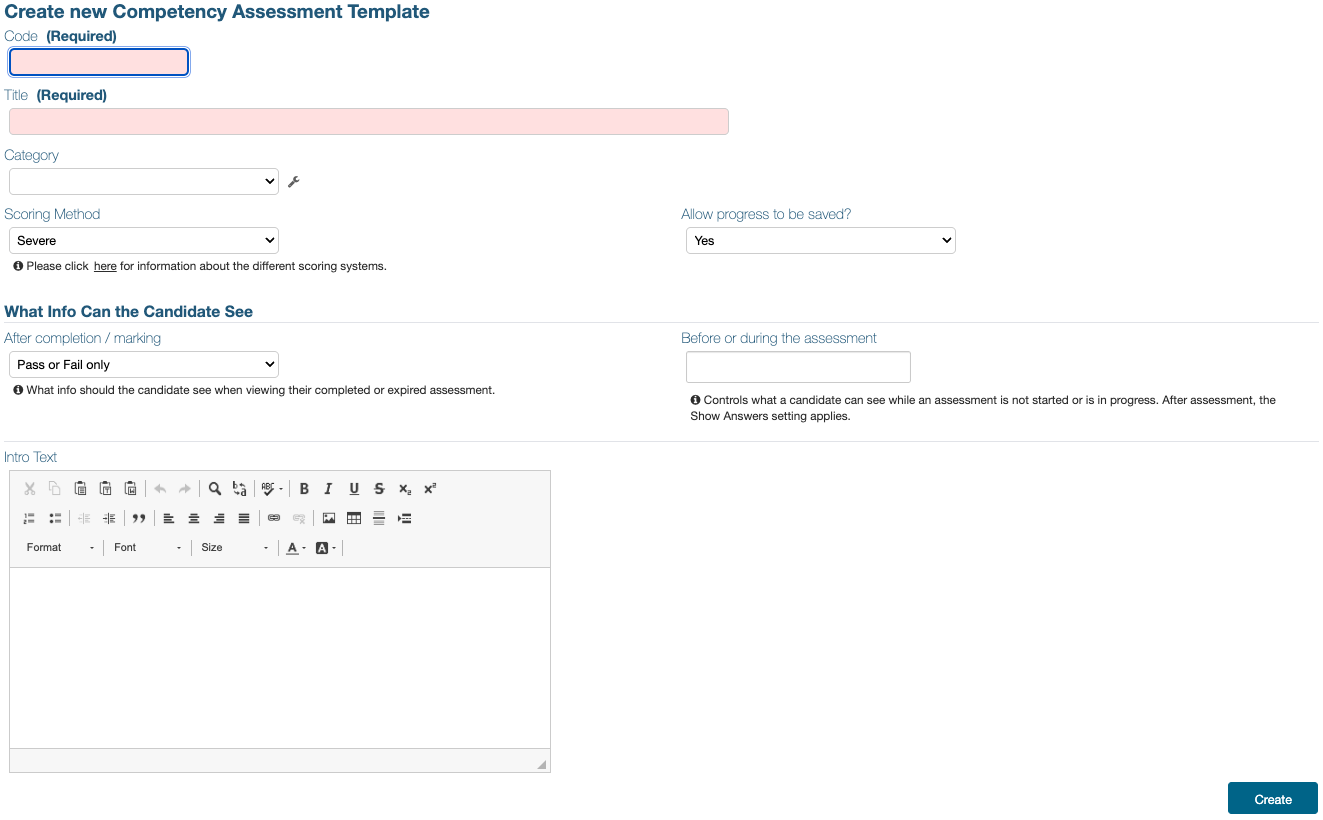
To create an assessment template:
- Click Competency > Assessment Designer and click the Create Assessment Template tab, or
- Click the Add (+) icon next to Competency > Assessment Designer
- If your account has more than one facility, select the facility in the required Select Facility field first. Changing the facility reloads the form so that look-up lists such as Category show the options for that facility
- Enter a code in the Code field
- Enter a title in the Title field
The following items are not required while the template is in draft mode: - Select a Category from the dropdown menu (more information below)
- Select a Scoring Method from the dropdown menu (more information below)
- Select whether it is allowed to pause the assessment and return to it later with the field, Allow progress to be saved? This is set to 'Yes' by default. When set to, 'Yes', a 'Save Progress' button will be added at the bottom of the assessment, which saves the candidate's changes but leaves the assessment open to complete later.
- Configure the, What Info Can the Candidate See section (more information below)
- The field, 'After completion / marking' has a dropdown menu from which one option can be selected.
- The field, 'Before or during the assessment' allows selecting multiple items from a list.
- Enter a description in the Intro Text field
- Click Create
Once the template has been created in draft mode, the same page shows some further settings:
- Pass Score - the score needed to pass, set in either points or percent
- Number of Questions - leave empty (shown as 'Ask all Questions') to ask every question, or set a number to have the system ask that many random questions from the template. Setting a value here also enables Randomise Questions
- Randomise Questions - presents the questions in a random order
- An Advanced Settings section containing Examiner Settings, Completion Settings, Reissue Settings, notification settings, the organisational units (OUs) the template applies to, and Reference Documents
Managing and Adding Categories
‘Categories’ help group and filter assessments (and other items in iPassport) but don’t impose restrictions on access. The Assessments section in iPassport has its own list of categories, not shared by other areas. Categories that are not in use can be deleted and this is noticeable because a delete (trash/bin) icon is visible under the Actions menu.
To add a category to an assessment template (while creating a template or still in draft mode):
- Click the edit (pencil) icon under Category
- Click inside the text box to reveal the dropdown menu of categories
- Click a category to select it
- Click Save
To populate the list of categories and make changes, please refer to the article Managing Configurable Look-up Lists.
Scoring Method
There are three choices for how the test should be scored. This only applies to checkbox (multiple choice) questions, which are marked automatically by the system.
Whichever scoring method is chosen, if a question has mandatory answers and the candidate does not select all of them, the question scores 0 points and is failed.
- Severe (this is the default scoring method for new templates)
- Moderate
- Lenient
How the scoring systems work
Severe
- If the candidate selects any incorrect answers they score zero points.
- Within each question,
- If the option 'for all correct answers' is selected, the candidate will score zero points unless all correct answers are selected.
- Otherwise, if the option 'for each correct answer' is selected, the candidate scores the sum of the correct answers selected, so long as the score is greater or equal to the minimum score set on the question.
Moderate
- If the candidate selects any incorrect answers, points are deducted as described below.
- CORRECT ANSWERS - Within each question,
- If the option 'for all correct answers' is selected, each correct answer is worth the maximum possible score, divided by the number of correct answers for the question.
- Score awarded per correct answer = (Score for all correct answers) / (Number of correct answers)
- otherwise, if the option 'for each correct answer' is selected, then each correct answer can be assigned its own score.
- If the option 'for all correct answers' is selected, each correct answer is worth the maximum possible score, divided by the number of correct answers for the question.
- INCORRECT ANSWERS - Within each question, and in both cases (whether 'for all correct answers' or 'for each correct answer' is selected),
- For each incorrect answer selected, the points deducted are worth the maximum possible score, divided by the number of incorrect answers for the question.
- Score deducted per incorrect answer = (Score for all correct answers) / (Number of incorrect answers)
- For each incorrect answer selected, the points deducted are worth the maximum possible score, divided by the number of incorrect answers for the question.
- The score is rounded to the closest integer; if the score is negative it is set to 0.
- The question is passed if the score is greater than 0 and greater or equal to the minimum score set on the question.
Lenient
- If there are only correct answers for the question and all are selected, the candidate scores full points.
- If there is one or more incorrect answer for the question and the candidate selects all answers they score 0 points.
- No points are deducted for incorrect answers unless all answers are selected which scores zero (if there is at least one incorrect answer).
- Within each question,
- If the option 'for all correct answers' is selected, each correct answer is worth the maximum possible score, divided by the number of correct answers for the question.
- Score awarded per correct answer = (Score for all correct answers) / (Number of correct answers)
- otherwise, if the option 'for each correct answer' is selected, then each correct answer can be assigned its own score.
- If the option 'for all correct answers' is selected, each correct answer is worth the maximum possible score, divided by the number of correct answers for the question.
- The question is passed if the score is greater than 0 and greater or equal to the minimum score set on the question.
What Info Can the Candidate See
After completion / marking
This field is also editable while the template is in draft mode. Its purpose is to choose what the candidate can see when their assessment results are submitted.
There are 4 choices:
- Pass or Fail only - (only the score and pass/fail result are provided to the candidate)
- Show failed questions - (a copy of the assessment is provided with each question marked '✔️' or '❌', but no details of checkbox answers are given)
- All info excluding examiner comments - (a copy of the assessment is provided with each question marked '✔️' or '❌', and details of which individual checkbox answers were correct)
- All info including examiner comments - (same as previous option but also including assessor comments added in checkbox questions)
Before or during the assessment
This field has been added for instances where assessments require preparation or completion of some task, after the assessment is assigned and before it's started.
It controls what the candidate can see while the assessment is not yet started or is in progress. After the assessment, the After completion / marking setting applies instead.
A dropdown menu provides the following options, which can be selected in any combination:
- Intro text
- Reference docs
- Questions
- Pass/Fail per question
- Candidate's answers
- Correct answers
- Score given
- Attachments
- Examiner guidance
- Examiner remarks
None of these options are selected on a new template. If nothing is selected, the candidate will not see any of this information before or during the assessment.
The candidate will be able to view the selected information but will not be allowed to populate the fields, even while the assessment is in progress.
Next step:
The next article covers Adding questions to a Draft Competency Assessment Template
Previous step:
The previous article covers Permissions and requirements to manage Competency Assessments
Was this article helpful?
That’s Great!
Thank you for your feedback
Sorry! We couldn't be helpful
Thank you for your feedback
Feedback sent
We appreciate your effort and will try to fix the article