Introduction
The document search screen can be used to search for specific documents, to export a report of selected documents and also to update ownership, sharing options and review workflows across multiple documents at once.
The Search tab opens by default when navigating to Laboratory Records > Controlled Documents.
Permissions
Controlled document permissions are particularly granular, allowing users to Edit SOPs yet only view Policies, for example. Every type of document (Policies, SOPs, etc.) has its own set of permissions(e.g., “Policies:View Authorised Policies”, “SOPs:View Authorised SOPs”).
The two basic forms of permissions required are: "< doc.type > :View Authorised < doc.type >" and "< doc.type > :Search < doc.type >" (e.g., “SOPs:View Authorised SOPs”, “SOPs:Search SOPs”). The ‘search’ permission gives access to the Search facility; the ‘view’ permission allows opening controlled documents once they are found through a search. Users without a ‘search’ permission can still open the Search screen if they own at least one controlled document, or if they have been granted access to documents through a skill. Which documents they can see, and which statuses and types they can filter on, depends on the OU preference, Allow Document Owners to perform any action on their documents, regardless of permissions.
Additionally, there are permissions to view Draft documents (e.g., “SOPs:View Draft SOPs”), permissions to view Superseded documents (e.g., “SOPs:View Superseded SOPs”) and permissions to view documents Under Review (e.g., “SOPs:View Under Review SOPs”).
Finally, when a controlled document expires or is made inactive, the permission, “Records:View Inactive Records” is required to view it.
All the permissions above, including “Records:View Inactive Records”, only apply in the Organisational Units (OUs) where the user has been granted them.
Document Search Filters
The main search filters under the tab, Search, are always visible. To save screen space, an additional set of search filters are normally hidden from view and they can be accessed by clicking the Advanced Search bar.
As search criteria is entered, the results are updated automatically in the table below the search area.
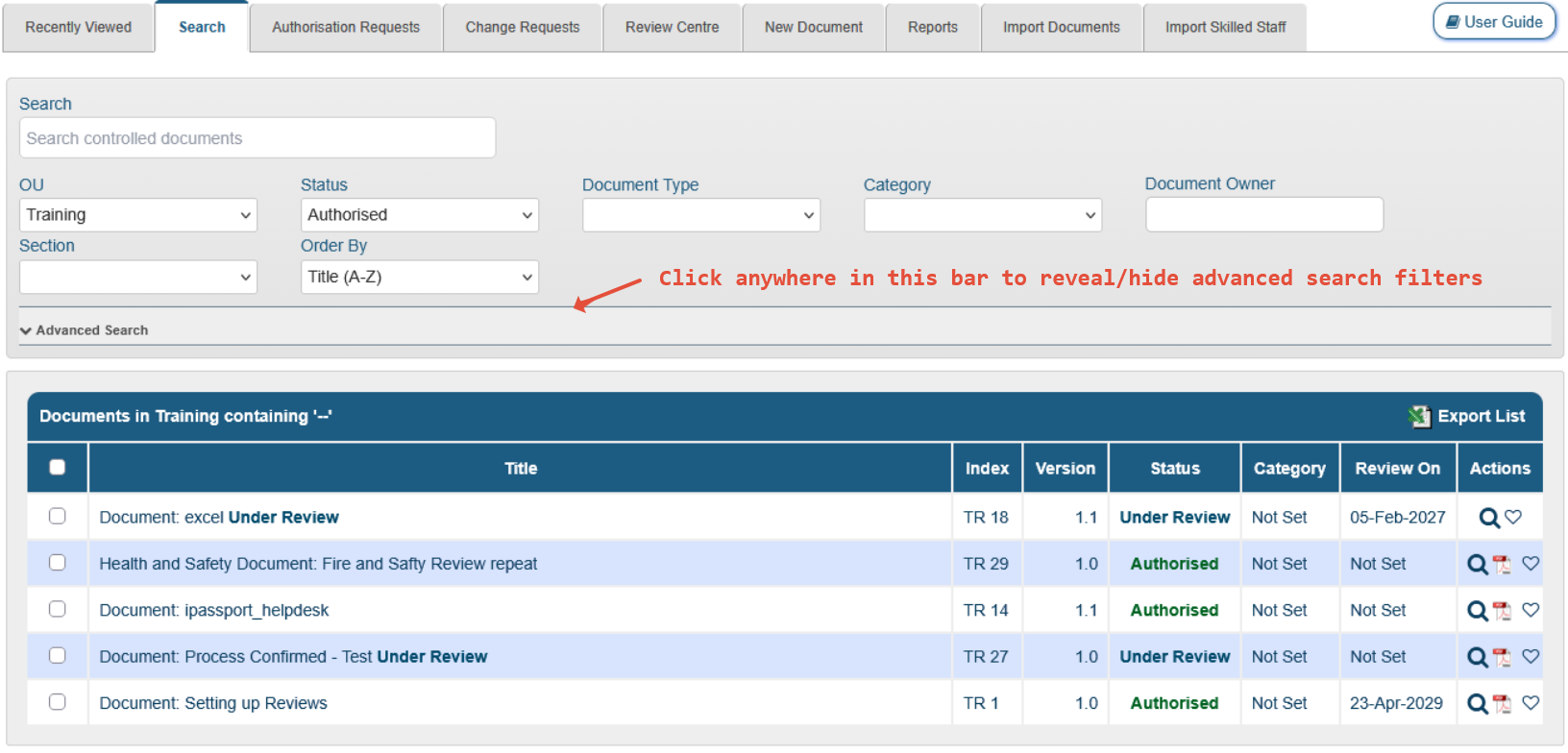
The main filters are:
- Search - free text can be entered; the system will search indexes, titles, barcodes and within the ‘Subject’ and ‘Introduction and Scope’ fields of controlled documents
- Facility - only shown on enterprise accounts; limits the OUs, categories and sections offered in the other filters
- OU - every controlled document lives in an OU; users can only see and select OUs where they have permissions to access controlled documents
- Status - the following choices are available, depending on the user’s permissions (for example, Draft and Pending Authorisation are only listed for users with permission to view draft documents, and Supersededonly for users with permission to view superseded documents):
- ‘Blank’ - selects all statuses
- Authorised - includes ‘Under Review’ and ‘Pending Release’
- Pending Release
- Draft - includes ‘Pending Authorisation’
- Pending Authorisation
- Superseded
- Under Review
- Document Type - there are 7 set types of documents in iPassport (leaving the field ‘Blank’ selects all types); only the types the user has permission to view or search are listed:
- COSHH Document
- Document
- External Document
- Health and Safety Document
- Job Description
- Policy
- SOP
- COSHH Document
- Category - categories are user created tags and their visibility can be limited to selected OUs, so the OU filter selection might affect which categories are displayed under this filter
- Document Owner - a search-as-you-type filter matches text entered to names of users in the account; the desired name must be selected from the dropdown list which appears under the field
- Section - a dropdown list of the ‘Locations’ which can be used as ‘Sections’ in documents; select the desired section from the list
- Order By- offers a set of options to sort the search results by,
- Title (A-Z)
- Title (Z-A)
- Index (A-Z)
- Index (Z-A)
- Version (Lowest First)
- Version (Highest First)
- Status (A-Z)
- Status (Z-A)
- Type (A-Z)
- Type (Z-A)
- Created At (Ascending)
- Created At (Descending)
- Expiry (Ascending)
- Expiry (Descending)
- Title (A-Z)
The Advanced Search filters are:
- Date - is after - is before -
The ‘date’ filter offers the options-- Created
- Review Due
- Superseded - when a start or end date is entered, the Status filter is ignored, so documents of any status within the date range are returned
- Last Reviewed
- Expiry Date
- Inactivated
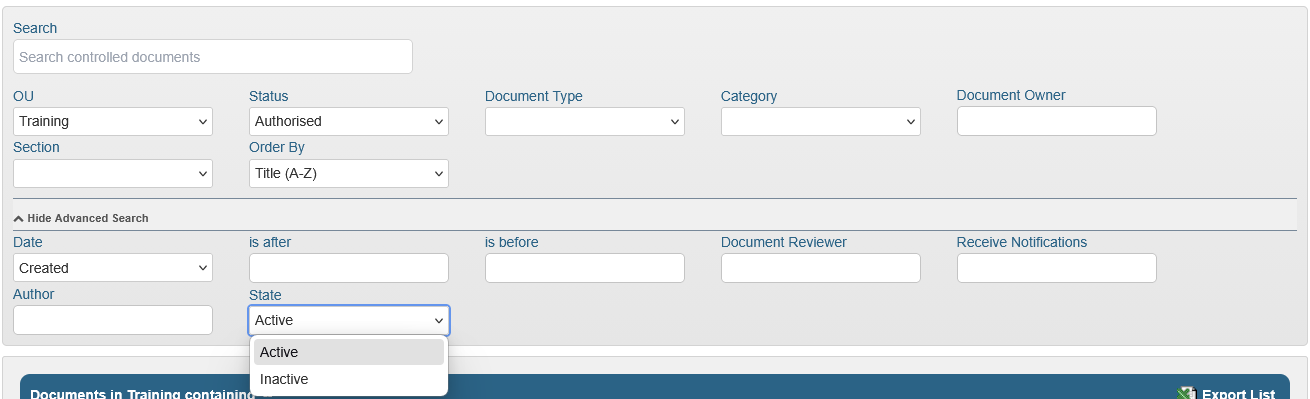
The other two fields (is after and is before) have pop-up calendars to define the start and end dates of the search scopeNote Expired documents are effectively ‘inactive’. Any documents that have already expired or which have been inactivated, will only come up in results if the State filter is set to, Inactive.
- Created
- Document Reviewer - a search-as-you-type filter matches text entered to names of users in the account; the desired name must be selected from the dropdown list which appears under the field
- Receive Notifications - a search-as-you-type filter matches text entered to names of existing users on review Notification Lists; the desired name must be selected from the dropdown list which appears under the field
- Author - a search-as-you-type filter matches text entered to names of users in the account; the desired name must be selected from the dropdown list which appears under the field
Note You can search for documents authored by inactive users, but a specific setting must be enabled first.
To do this, go to Administration > Settings > System Preferences, then open the Miscellaneous Settings tab.
There, enable the option 'Show Inactive Users in Lists'.
Once this preference is active, you’ll be able to select the name of an inactive user in the Author field to find documents they authored.
This preference applies to all the user search-as-you-type filters (Document Owner, Document Reviewer and Author), not just Author.

- State - only allows choosing between Active or Inactive ; it always defaults to Active, keeping retired documents out of the lists unless required
This filter is only shown to users who have the permission, “Records:View Inactive Records”; for other users, results are always limited to active documents.
| Note |
| FINDING INACTIVE DOCUMENTS Retired / ‘inactive’ documents are hidden by default. They are easily revealed if the State filter is set to, Inactive (this requires the permission, “Records:View Inactive Records”). |
Exporting Search Results
The results from a search performed with any of the criteria above can be exported as a spreadsheet in CSV format by clicking, Export List (found in the top right corner of the results table).
In addition to the columns displayed on screen, these reports include all the metadata of the documents and information about their reviews.
Updating Multiple Documents
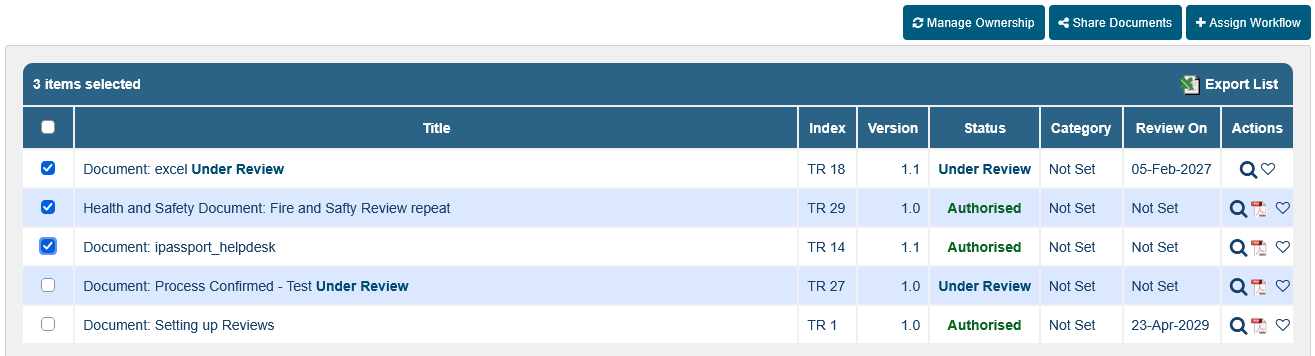
The results table has a checkbox on each row; the checkbox in the header selects all the documents listed. Once documents are selected, the following buttons can be used, depending on the user’s permissions:
- Manage Ownership - changes the ownership of the selected documents; requires permission to manage document ownership
- Share Documents - shares the selected documents; requires permission to share documents, and document sharing must be enabled in the OU preferences
- Assign Workflow - assigns a review workflow to the selected documents; requires permission to schedule reviews
New Search (Beta)
The New Search (Beta) is an optional feature. It only appears when the Search Indexing module is enabled for the account; users on other accounts will not see it and continue to use the search screen described above.
When the feature is available, a Try the New Search (Beta) checkbox is shown on the search screen. It is unticked by default, so the standard search is used unless the user opts in by ticking the checkbox. While the documents are being indexed, or if indexing has failed, a progress or failure message is shown instead of the checkbox.
Ticking the checkbox replaces the standard search with the new search screen, which offers:
- a Search document contents toggle (On/Off)
- a State option of Active and Inactive
- paginated and infinite-scroll display of results
- favourites
- the same actions for updating multiple documents as the standard search
The choice is remembered in the browser, so the same search screen opens next time.
Was this article helpful?
That’s Great!
Thank you for your feedback
Sorry! We couldn't be helpful
Thank you for your feedback
Feedback sent
We appreciate your effort and will try to fix the article