Creating a New Checklist
Introduction
| Note |
| PLEASE NOTE: iPassport contains two elements in its Quality Management module: Checklists and Standards. These words are used differently on either side of the Atlantic and can cause confusion. Within iPassport, ‘Standards’ refer to regulations issued by a body such as CAP or ISO, whereas iPassport’s ‘Checklist’ functionality allows users to design and create the content of an audit by combining requirements from imported standard sets with additional user-generated items. |
Checklists are currently central to the audit process within iPassport. They can be based on questions designed by users or on questions extracted from standards. Once a checklist is created within iPassport, it can be used time and again for audits. iPassport includes designated fields to allow auditors to respond to each item in a checklist within iPassport directly. With smart device compatibility, iPassport offers the ability to conduct audits and add responses in a live setting. Alternatively, checklists can be printed so that findings can be recorded manually before feeding them back into iPassport. This information can then be actioned if necessary, using the task engine within iPassport. Please refer to the user guide, Internal Audit Management for more information about this.
| Note |
The checklist itself is a stand alone item and to enter the findings into iPassport, an Audit needs to be created. |
Creating a new checklist
iPassport Checklists have been designed to be used in conjunction with an audit; an audit can be easily configured with one or more checklists. A checklist can be built up either directly from standards (already imported to the account), from a series of questions designed by the user or from a combination of the two.
Permissions Required
The following permissions are needed to create and build checklists:
- Checklists:Create Checklists - to see the New Checklist tab and create a checklist
- Checklists:Edit Checklists - to add sections, steps and standards (Add Section, Add Step, Add Standard) and to reorder them
- Checklists:Delete Section Steps - together with Checklists:Edit Checklists, to delete steps, standards and empty sections
- Standards:Search Standards - to search for standards in the Add Standard pop-up window
To create a new checklist:
- Go to Quality Management > Checklists > New Checklist (or use the add [+] sign as a shortcut)
- Select the Organisational Unit the checklist belongs to (this is a required field; only OUs where you have permission to create checklists are listed)
- Enter a relevant name for the checklist in the field, Name (this is a required field)
- Select a List Type to help classify it (optional field)
- Enter free text in the Header section (optional field)
- Click Create Checklist

[[SCREENSHOT NEEDED: Quality Management > Checklists > New Checklist form showing the Organisational Unit, Name, List Type and Header fields and the Create Checklist button]] - Click the Contents tab
- Click [+]Add Section
Note A section must be added before standards or steps can be added.
- Enter an index in the Index field
Note Only numbers can be entered (a decimal place is allowed); they help ordering and differentiating the sections. This field is required and each index must be unique within the checklist.
- Enter a name for the section in the Heading field (this is a required field and must be unique within the checklist). If standards are used, it should make reference to them for clarity.
- Click Add Section to expand the area for new additions

- To populate the section, click the Steps (three vertical dots) icon under Actions. The same column also has an edit (pencil) icon to edit the section and, once the section has no steps, a delete (trash/bin) icon to remove it (deleting a section requires the permission Checklists:Delete Section Steps)
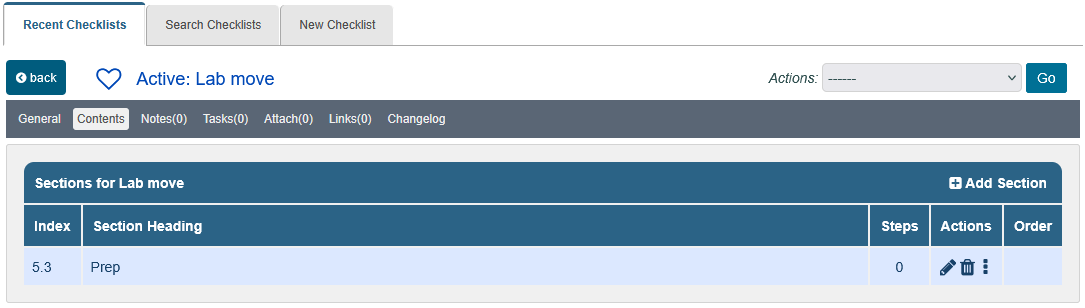
- To add a standard, click (+)Add Standard
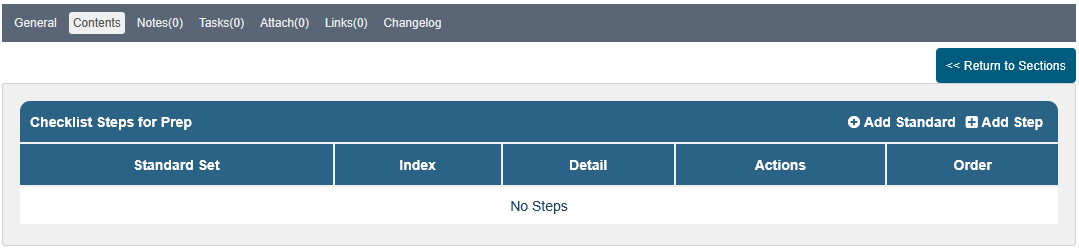
- Enter a standard search term (e.g., 5.3.1) in the Add Standard pop-up window to find available standards
Note Only standards (Entry items, not headings) from standard sets that have been signed off and are not archived are listed; draft standard sets do not appear. Standards already added to this section are not listed. If a standard has already been added to the checklist, the message, “This standard has already been added to this checklist. Please choose another.” is shown. The permission Standards:Search Standards is required to use the Add Standard pop-up window.
- Select an OU to display only standards from that OU
- Click the link (chain) icon under the Link column of the standard to add that item
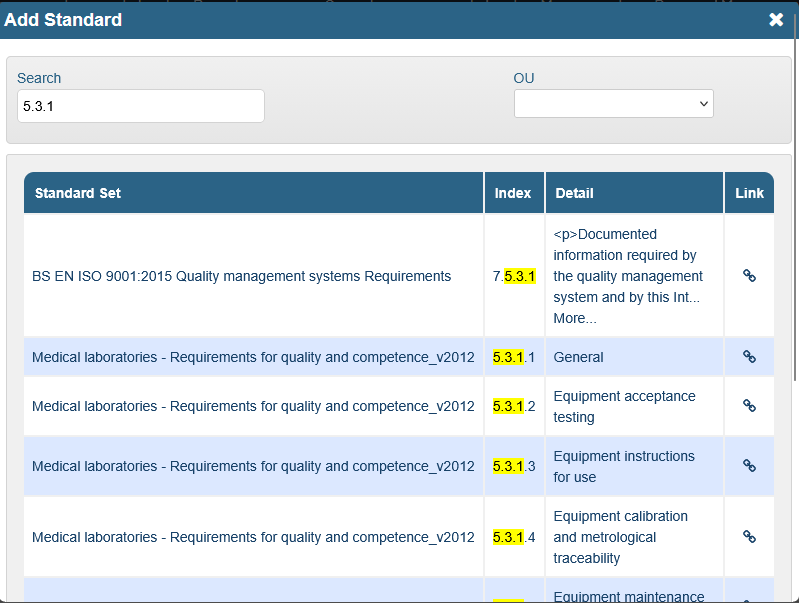
Note Standards can only be searched in the OUs the user has access to.
- To add a user designed question, click [+]Add Step to expand the area
- You can leave the Index field blank to let the system auto-generate it
- Enter free text in the Step Detail field
- Click Add Step
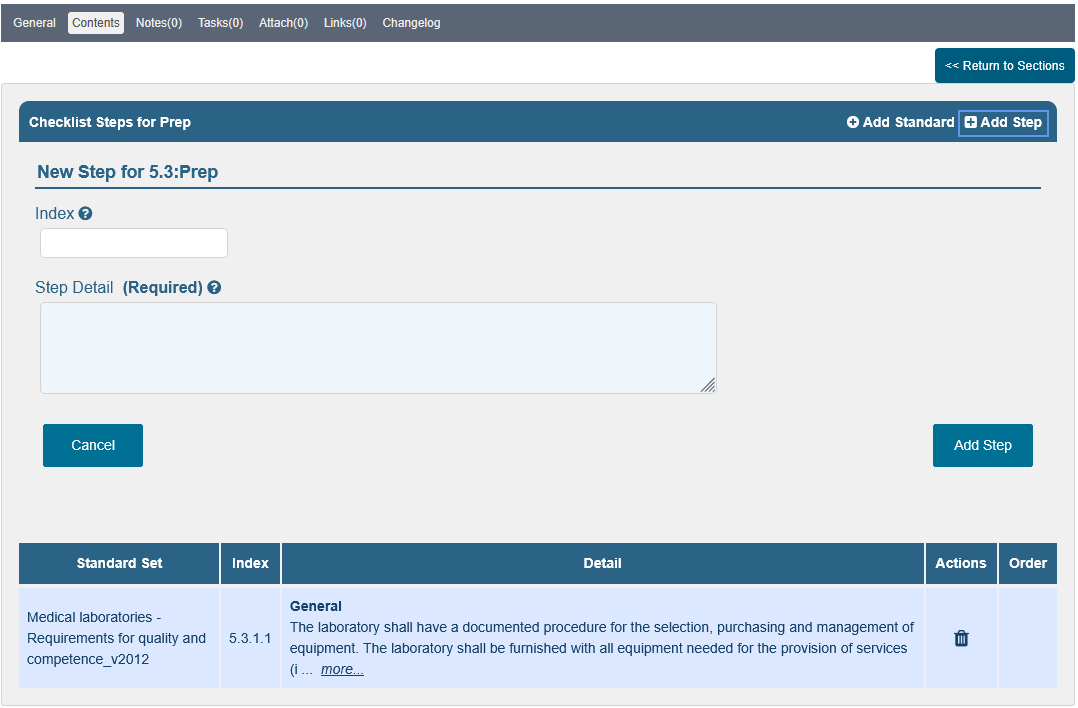
- When all steps have been added, click Return to Sections
- Additional sections can be added following the steps above
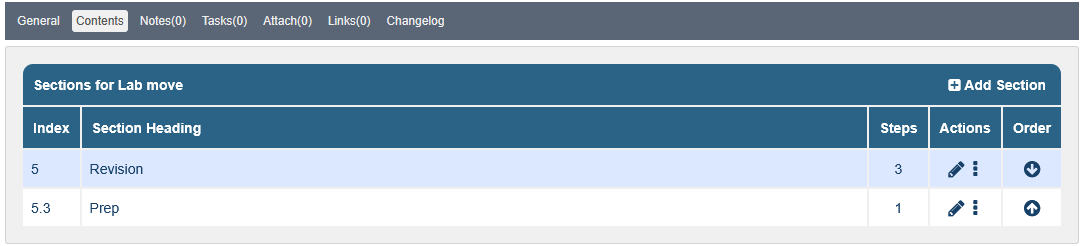
The number of standards and user designed steps added are grouped under the column, Steps for each section.
Standards and steps can be deleted by using the trash/bin icon under Actions (this requires both Checklists:Edit Checklists and Checklists:Delete Section Steps). Steps can be edited. When they are added, they get placed at the bottom of the list. The arrows under Order allow moving the standards and steps into the desired order.
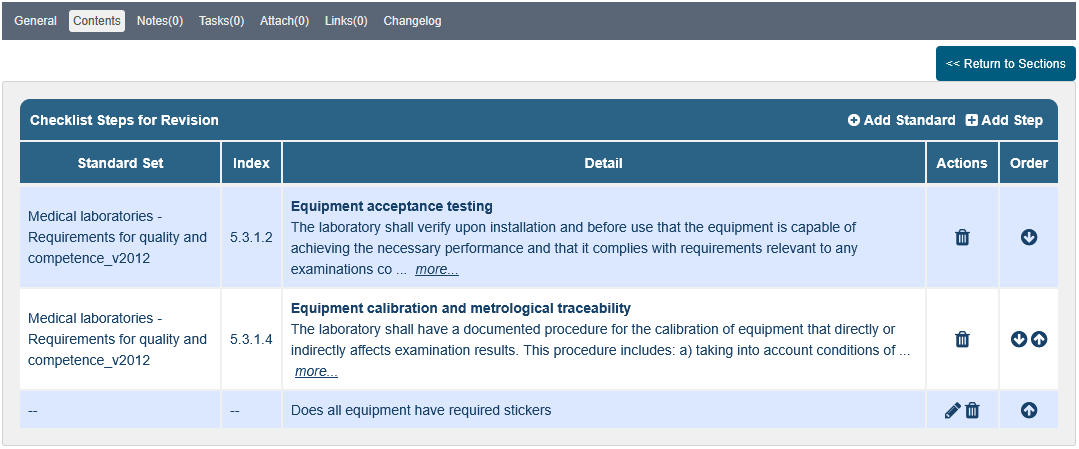
Once all sections have been added, the checklist is complete and can be used as part of an audit.
The checklist's Actions dropdown menu also offers the following options (permissions dependent):
- Clone Checklist - requires Checklists:Create Checklists
- Export to CSV - requires Checklists:Print Checklists
- Set as Inactive / Set as Active - requires Checklists:Enable/Disable. Inactive checklists are not offered when adding checklists to an audit.
Managing Checklist Types
Instructions on how to manage this configurable look-up field can be found in this article: Managing Configurable Look-up Lists
This video helps understand the steps visually:
Was this article helpful?
That’s Great!
Thank you for your feedback
Sorry! We couldn't be helpful
Thank you for your feedback
Feedback sent
We appreciate your effort and will try to fix the article